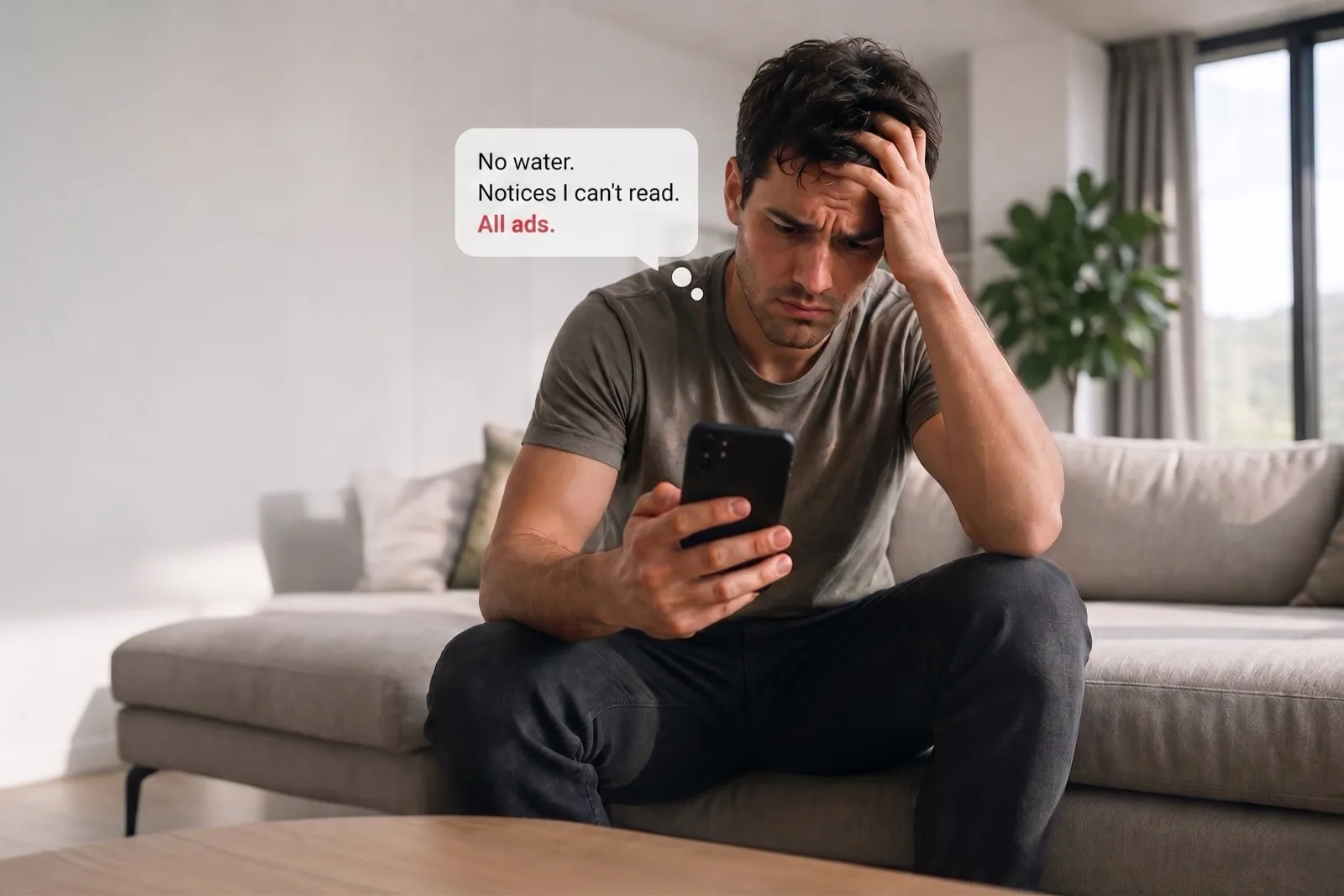
It was a Tuesday morning in Bangkok, and Mark was mid-shower when the water stopped. Not a trickle — nothing. He wrapped a towel around himself and checked his phone, the one place his condo's app was supposed to have already told him this was coming.
The app had posted a notice the night before: a scheduled water shutoff, 8 a.m. to 11 a.m. It was clear, timely, and completely useless to him — written only in Thai, which Mark, three years into living in Thailand, still reads far less comfortably than English. And even if he had understood it, getting to it wasn't simple: every time he opened the app to check notices, a full-screen ad loaded first — a café discount, a gym promotion, a laundry-service deal — before he could get through to anything else. The notice he actually needed was always one ad-wall away.
Nothing about that ad needed to load first for it to work. The notice that did need speed didn't get any priority at all. This isn't a rare glitch — it's a pattern across condos and apartments with sizable expat populations, from Bangkok to Chiang Mai to Phuket, and it says something about how many property management apps are actually built.
What's actually happening here
Most property management apps are free to residents and monetised elsewhere, often through advertising and sponsored placements. That's not inherently wrong, but it creates a quiet incentive problem: the feature that drives revenue — ad impressions — gets priority, while the feature that protects residents — accurate, multilingual, time-sensitive alerts — becomes an afterthought.
Multilingual resident communication isn't a nice-to-have in Thailand's condo market, where many buildings have a large share of foreign residents who read Thai with varying fluency, if at all. When a water shutoff notice or emergency building alert is written in Thai only, it serves whoever happens to read the default language the juristic office's staff used to draft the post — not the whole building. The result: an expat resident gets caught without water or air conditioning, a foreign resident misses an evacuation notice during a real emergency, or a resident who relies on a Thai-speaking friend to translate finds out only after the fact.
None of this stems from malice. It stems from a business model that rewards ad frequency over notice accuracy, layered on top of a practical reality: most juristic offices in Thailand operate day-to-day in Thai, with English as an occasional courtesy rather than a built-in standard.
Why this keeps happening
Advertising-supported property management apps generate revenue when residents see and engage with ads, so ad content gets tested and sent frequently. English translation, by contrast, costs money to build and maintain but doesn't directly generate revenue — so it's easy for that investment to get deprioritised, even with good intentions.
Translation is also harder than it sounds. A one-time welcome packet is a project; ongoing translation of a shutoff window that changes by an hour, or an evacuation route that differs by floor, is a process. Some apps solve this only partially, translating general announcements but not same-day operational alerts. Partial translation can be more dangerous than none at all, because it creates false confidence instead of informed caution. Generic, literal machine translation adds a further risk of its own: stiff or context-blind phrasing can leave residents with an inaccurate sense of what's actually happening.
Who this affects most
Expat renters and condo owners
They read English more comfortably than Thai, and rely on accurate translation for safety-critical information.
Retirees and long-stay visa holders
They often depend on a Thai-speaking partner or neighbour to translate notices after the fact — too late to act.
Mixed-nationality buildings
Juristic office communications are drafted once, in Thai, and posted for everyone the same way.
Juristic offices and property managers
They field the aftermath: a resident upset and confused, turning a preventable gap into an in-person complaint.
What resident-first communication should look like
Life-safety and operational alerts translated by default, not as a premium add-on.
Critical notices prioritised ahead of promotional content, in both timing and visual hierarchy — never gated behind an ad before a resident can reach them.
Verifiable delivery, so juristic offices can confirm who received and opened a notice, not just that it was posted.
Complete, natural-reading translation coverage, not partial or literal — including notices generated on short notice by maintenance or security staff.
None of this requires giving up advertising as a revenue model. It requires sequencing: the platform should make it structurally impossible for a promotional message to reach residents faster than a life-safety one. That's a design choice, not a technical limitation.
The cost of getting this wrong
A missed notice rarely gets a formal complaint the first time — residents just quietly stop trusting the app, which makes them less likely to see the next critical alert. Beyond eroded trust, there is real property risk, reputational risk, and staff time consumed by escalations that a working translation workflow would have prevented.
Practical steps for juristic offices and property managers
Audit your last 90 days of notices: how many were promotional versus operational, and how many of the operational ones were translated?
Survey residents' language needs — buildings are often more linguistically mixed than assumed.
Separate critical alerts from promotions in your workflow, even manually, until your platform does it automatically.
Ask vendors directly whether translation is core or an add-on, whether it uses context-aware AI or literal machine translation, and whether they report delivery by language.
Document and train staff on your emergency communication protocol, including who translates what, and how fast.
How QasaLiving solves this
QasaLiving is a property management app built on the premise that the message that matters — a shutoff, an evacuation notice, a safety update — should never compete with a coupon for a resident's attention, and it should never be the one notice that didn't get translated.
Unlike apps that rely on generic machine translation, QasaLiving's translation is powered by AI built to capture context and cultural nuance, not word-for-word substitution. The result is a shutoff or emergency notice that reads naturally, as if written by a native speaker of the target language, rather than a stiff, literal rendering from a tool like Google Translate. That distinction matters most in exactly the situations where clarity is critical: safety and emergency notices, where an awkward or context-blind translation creates confusion instead of removing it.
How QasaLiving supports multilingual alerts
| Core task | How QasaLiving helps |
|---|---|
| Multilingual alerts | Critical and operational notices are translated automatically using context-aware AI, not word-for-word machine translation, so the message reads naturally — and never as a paid add-on. |
| Priority over promotions | Safety and maintenance alerts are never gated behind an ad, in either timing or visual hierarchy. |
| Delivery you can verify | Juristic offices see exactly who received and opened each notice, broken down by language. |
| Mixed-nationality buildings | Designed for buildings whose residents read different languages with different levels of fluency. |
- Multilingual alerts
- Critical and operational notices are translated automatically using context-aware AI, not word-for-word machine translation, so the message reads naturally — and never as a paid add-on.
- Priority over promotions
- Safety and maintenance alerts are never gated behind an ad, in either timing or visual hierarchy.
- Delivery you can verify
- Juristic offices see exactly who received and opened each notice, broken down by language.
- Mixed-nationality buildings
- Designed for buildings whose residents read different languages with different levels of fluency.
Frequently asked questions (FAQ)
What is a translated condo notice, and why does it matter for expats in Thailand?
It is any official building communication — maintenance, assessment, or emergency notices — provided in a resident's primary language, not just Thai. It matters because missing one in an unfamiliar language can mean missing safety-critical information.
Why do condo apps in Thailand send so many ads but so few translated alerts?
Ad-supported apps profit from ad frequency, not translation, so English translation often gets deprioritised — especially where day-to-day management runs in Thai by default.
Is QasaLiving's translation the same as Google Translate or other machine translation tools?
No. QasaLiving uses AI built to capture context and cultural nuance rather than translating word-for-word, so notices read naturally in each language. That distinction matters most for safety-critical notices, where a literal or context-blind translation can create confusion.
Are juristic offices in Thailand required to communicate in English?
Requirements vary under Thailand's Condominium Act and each building's house rules, so confirm the specifics with a local property lawyer. Most juristic offices are not legally required to translate, which is why it usually falls to platform or building policy rather than regulation.
What should a juristic office look for in a property management platform?
Default, context-aware translation for critical alerts, delivery and read reporting by language, clear separation of promotional and operational content, and transparent notification controls — not just Google Translate, ads, and general announcements.
Bring multilingual alerts into one place with QasaLiving
Mark's story isn't really about a broken pipe. It's about a broken priority — a system that reached him often for things that didn't matter, and once for something that did, in a language he couldn't read. A platform like QasaLiving puts multilingual, life-safety communication back where it belongs: ahead of the ads rather than behind them, translated with AI that understands context, not just words.