Managing a condo juristic office smoothly is more complex than many people expect. It spans common-area finances and fee collection, maintenance and repairs, security, resident communication, the annual general meeting, and legal compliance. Whether you are a newly elected committee member, a co-owner who wants the full picture, or a management company improving your systems, this guide walks through every part of condo juristic office management, step by step, along with the tools that make the work easier and more transparent.
What is a condo juristic person?
A condo juristic person is an entity formed under the Condominium Act to look after and manage a condo's common property: the lobby, lifts, pool, electrical systems, parking, and other shared areas. It is a legal person in its own right, so it holds rights and duties separately from individual co-owners: collecting common-area fees, signing contracts with vendors, and suing or being sued in its own name. Its core purpose is to keep the common property in good condition and shared living orderly.
Structure and roles in condo management
Managing a juristic office involves several parties with different roles. Understanding who does what keeps everyone aligned.
Co-owners
Every unit owner is a co-owner of the common property and votes at the general meeting in proportion to their ownership ratio.
The committee
The committee is a group of representatives elected by co-owners at the general meeting to set policy and make decisions on their behalf. By law it has up to 9 members serving 2-year terms (verify against the current law).
The juristic manager
The juristic manager handles day-to-day operations according to the resolutions of the meeting and committee. This may be an appointed individual or a management company hired to run things.
The management company
Many projects hire an external property condo management company rather than self-managing, because a firm brings a ready-made team and systems. Choosing the right management company matters a great deal.
The core areas of managing a condo juristic office
Juristic management covers several interconnected areas. These are the six every project must handle.
Finance and accounting
Transparent, auditable finances are the heart of good management. This area covers the annual budget, billing and collecting common-area fees by ownership ratio, maintaining a sinking fund for major future repairs, preparing financial statements, and chasing overdue fees, one of the most common problems and a direct hit to a project's cash flow.
Maintenance and repairs
Keeping the common property in good shape means both preventive work (scheduled checks of lifts, water pumps, and electrical systems) and repairs reported by residents. A clear system for maintenance tickets and status tracking prevents jobs from slipping through the cracks and reduces complaints.
Resident communication
From posting notices and handling complaints to answering day-to-day questions, fast and organised communication dramatically reduces misunderstandings and conflict in a project.
Security and visitor management
Security work covers overseeing guards, controlling access, and logging visitors, both for residents' safety and for later review.
Legal and compliance
A juristic person must comply with the Condominium Act and its own regulations, including signing contracts, keeping key records, and correctly carrying out meeting resolutions.
The annual general meeting (AGM)
By law, a juristic person must hold its annual general meeting within 120 days of the fiscal year-end to approve the financial statements, elect the committee, and decide other important matters. Good preparation keeps the meeting running smoothly and makes quorum easier to reach: notice given in advance, the agenda and documents distributed beforehand, and resolutions recorded properly.
Common challenges in condo management
Even with a clear scope, many juristic offices face the same recurring problems that undermine both finances and resident satisfaction.
Overdue fees that hurt cash flow and take time to chase.
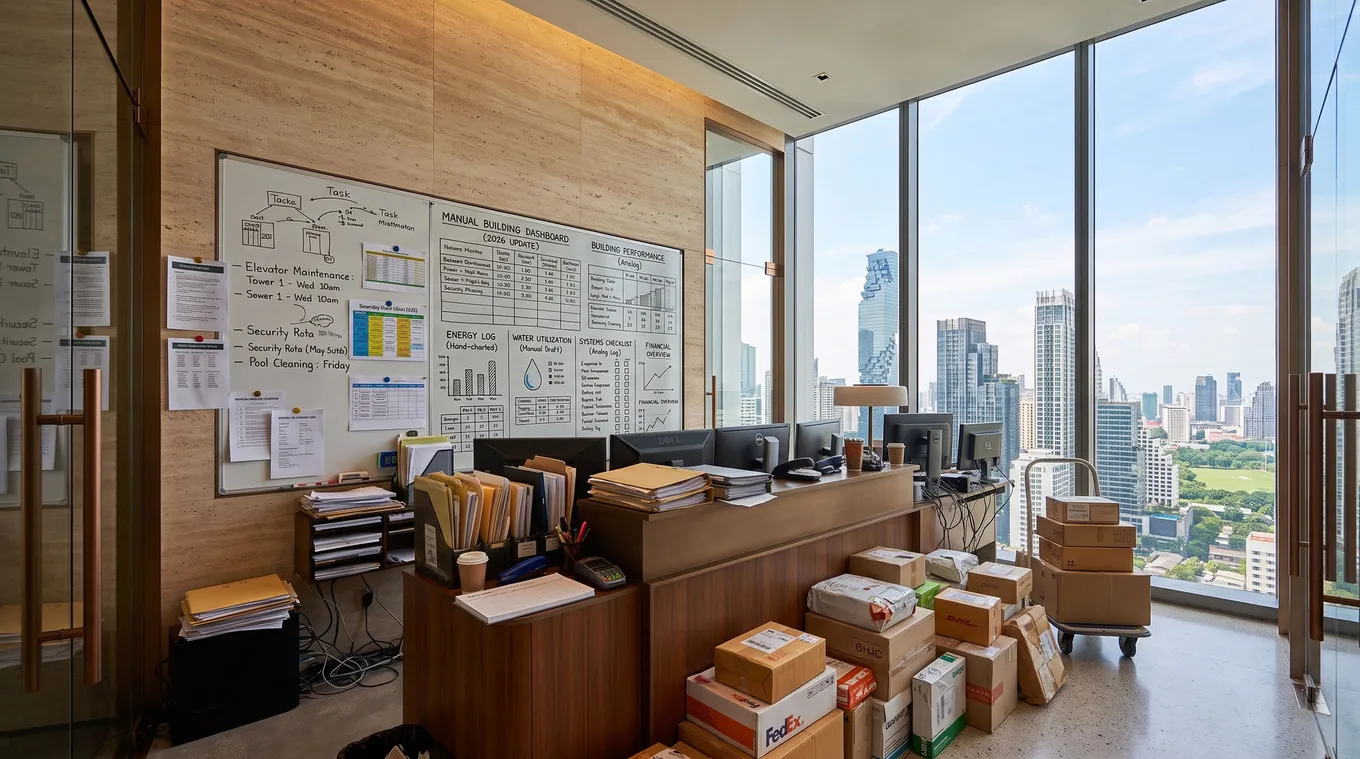
Manual paperwork that is slow and error-prone.
Dropped complaints and communication that leave residents unhappy.
Financial transparency increasingly demanded by co-owners.
Frequent manager or staff turnover that breaks service continuity.
Self-manage or hire a management company?
Some smaller projects self-manage to save cost and keep full control, at the price of workload and specialist knowledge. Hiring a property management company brings a ready team and systems, but the choice must be made carefully. Either way, good tools make both approaches more transparent and efficient.
How QasaLiving helps with managing a condo juristic office
All six areas above are connected, so running separate systems (accounting in one place, maintenance tickets in another, notices over chat apps) scatters data, makes auditing hard, and lets work slip. That is why a single all-in-one platform helps so much.
QasaLiving is an all-in-one juristic-management platform built to bring every core task of a condo juristic office into one system, for both the management team and residents:
Accounting & fee collection: online billing, fee calculation by ownership ratio, online payment, overdue-debt tracking, and transparent financial statements.
Maintenance tickets: residents report and track repairs themselves; staff assign, track, and close jobs cleanly.
Resident app: notices, parcel alerts, facility booking, and contact with the juristic office in one place.
Visitor management & security: log visitors and control access to keep residents safe.
How QasaLiving supports each core task
| Core task | How QasaLiving helps |
|---|---|
| Finance & accounting | Online billing, fee calculation by ownership ratio, online payments, overdue-debt tracking, and financial statements co-owners can actually see. |
| Maintenance & repairs | Residents submit tickets in the app; staff assign, track status, and close jobs so nothing slips. |
| Resident communication | Announcements, complaint intake, and parcel alerts in one channel, so fewer messages go missing. |
| Security & visitor management | Digital visitor logs and access control, with records you can review later. |
| Legal & documents | Central storage for key documents and resolutions, so records are easy to keep and find. |
| The AGM | Send notices, share the agenda and documents, and keep residents informed ahead of the meeting. |
- Finance & accounting
- Online billing, fee calculation by ownership ratio, online payments, overdue-debt tracking, and financial statements co-owners can actually see.
- Maintenance & repairs
- Residents submit tickets in the app; staff assign, track status, and close jobs so nothing slips.
- Resident communication
- Announcements, complaint intake, and parcel alerts in one channel, so fewer messages go missing.
- Security & visitor management
- Digital visitor logs and access control, with records you can review later.
- Legal & documents
- Central storage for key documents and resolutions, so records are easy to keep and find.
- The AGM
- Send notices, share the agenda and documents, and keep residents informed ahead of the meeting.
The advantage is that everything lives in one system, so data isn't scattered and the team and residents work from the same up-to-date picture. The resident app is free to use, while the management side is billed based on usage, so you can start without a heavy upfront cost. That makes it a fit for both property management companies running many projects and juristic offices that want to self-manage professionally.
In practice that means fewer overdue fees slipping through the cracks, complaints resolved faster, finances residents can genuinely see, and service that stays consistent even when managers or staff change.
Frequently asked questions (FAQ)
How are common-area fees calculated?
They are generally calculated from each unit's ownership ratio multiplied by the per-square-metre rate agreed at the general meeting.
When must the AGM be held?
Within 120 days of the fiscal year-end, to approve the financial statements and other key matters.
How many committee members, and for how long?
By law, up to 9 members serving 2-year terms (verify against the current law).
What is the difference between a juristic person and a management company?
The condo juristic person is the condo's legal entity, of which co-owners are members; a management company is an external contractor hired to run management on its behalf.
Bring every part of condo management into one place with QasaLiving
Good management of a condo juristic office means keeping finance, maintenance, communication, and legal compliance moving together, transparently and systematically. Get these foundations right and residents live comfortably, the committee's job gets easier, and everyone's property value is protected. QasaLiving brings all of it into a single platform, so both management companies and self-managed juristic offices can run everything in one place. See how it fits your condo below.